



Any digital transformation effort that fails to modernize the user experience is unlikely to deliver the results leaders expect.
Most organizations are no longer debating whether to transform. They are grappling with how to do it without disrupting operations, fragmenting systems, or exhausting their teams. For technology-enabled services (TES) organizations in particular, transformation has become a recurring reality rather than a one-time initiative.
Digitizing workflows and deploying new platforms is no longer enough. Growth stalls when the digital layer that connects people, processes, and data fails to evolve alongside the service model itself. An improved process only creates value if it is intuitive, usable, and adopted at scale. That level of adoption only happens through intentional UX modernization.
UX is no longer about surface-level usability or visual polish. It has become a strategic discipline that determines how effectively employees deliver services, how confidently customers engage with platforms, and how well organizations scale human expertise through technology. When UX modernization is treated as a core transformation lever, returns compound over time through improved adoption, efficiency, and competitive advantage.
Why UX Modernization Is Mission-Critical to Transformation
UX has always mattered, but it becomes mission-critical during moments of organizational inflection. These moments occur when growth, complexity, and scale begin to outpace the systems supporting them.
Technology-enabled services organizations often reach this point quietly. Service offerings evolve. Teams grow. New markets open. Yet the digital tools underpinning daily work, such as portals, internal platforms, and workflow systems, remain rooted in legacy assumptions.
Digital transformation initiatives are typically launched to address these gaps. However, when modernization efforts happen in silos and lack a shared experience vision, they often introduce new friction instead of removing it.
When centralized IT or product teams cannot move quickly enough, departments understandably take matters into their own hands. Common responses include:
- Adopting point solutions to solve immediate operational pain
- Building quick fixes using low-code or no-code tools
- Deferring action while waiting for enterprise systems to catch up
Each approach can provide short-term relief. Over time, however, they introduce design debt, integration challenges, and inconsistent experiences that limit adoption and scalability.
Consider common scenarios:
- A regional services team adopts its own CRM instance to speed up engagement, but it remains disconnected from enterprise data and reporting.
- A product group modernizes a customer portal using a standalone platform that does not align with broader service workflows.
- A support organization rolls out a new enterprise tool while carrying forward outdated workflows, missing the opportunity to rethink the experience entirely.
In each case, speed wins, but alignment, adoption, and long-term value suffer. UX modernization bridges this gap by aligning business intent, technology capability, and human experience into a cohesive system that can scale.
UX Modernization Lives at the Intersection of Business, Technology, and People
The most effective way to understand UX modernization is to see it as the connective tissue between three forces: business goals, technology systems, and human behavior.
When these forces are misaligned, transformation stalls. When they are intentionally brought together, modernization becomes sustainable.
Business leaders focus on efficiency, growth, and differentiation. Technology teams prioritize scalability, security, and maintainability. Users, both employees and customers, care about clarity, speed, and confidence. UX modernization is where these priorities converge.
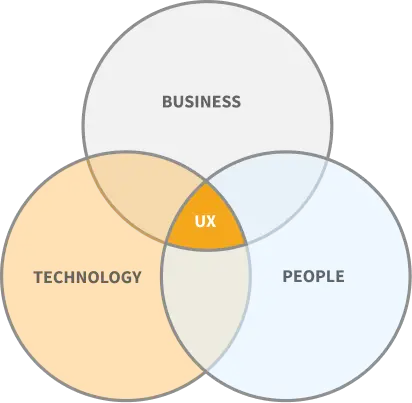
In technology-enabled services organizations, this alignment is especially critical. Technology does not replace the service. It amplifies it. When the experience layer creates friction, service quality and scale both suffer.
Forward-thinking leaders understand that transformation is not about implementing tools. It is about enabling people to perform at their best through systems that feel intuitive, supportive, and aligned with how work actually happens.
Designing for People, Not Just Processes
For decades, organizations trained people to adapt to tools. In the modern service economy, that model no longer works.
Employees today are active participants in digital systems rather than passive users. They make decisions, customize workflows, interpret data, and interact directly with customers through digital platforms. When tools fail to reflect how people think and work, productivity declines and workarounds become the norm.
UX modernization reverses this dynamic. Instead of forcing people to conform to rigid systems, it reimagines systems around human behavior, context, and intent.
Organizations that adopt this mindset see tangible results:
- Faster onboarding and reduced training costs
- Higher adoption of internal and customer-facing tools
- Fewer support issues driven by usability gaps
- Greater return on existing technology investments
Designing for people is no longer a competitive advantage. It is the baseline for sustainable transformation.
Three Principles for Strengthening Transformation Through UX Modernization
Organizations that succeed in digital transformation consistently apply three principles. While they may sound simple, executing them requires discipline and leadership alignment.
1. Align UX Modernization With Business Values and Strategy
Transformation is as much cultural as it is technical. Digital systems inevitably reflect the values of the organizations that build them.
A company that prides itself on white-glove service may initially invest in tools that empower internal teams. As customer expectations evolve toward self-service, transparency, and speed, that same organization must rethink how its digital experiences express those values.
Without clear alignment, modernization efforts are easily misinterpreted. Automation can feel like a threat. Self-service can feel like cost-cutting. Resistance grows when people do not understand why systems are changing.
When UX modernization is explicitly tied to business values and strategy, experiences reinforce what the organization stands for. Change then feels purposeful rather than imposed.
2. Take an Incremental, Experience-Led Approach
The idea of a “big bang” transformation is largely a myth. Successful modernization happens in phases.
Legacy systems, fragmented workflows, and entrenched habits cannot be replaced overnight. What matters is visible and meaningful progress that builds trust.
Leading organizations focus on:
- Modernizing high-impact workflows first
- Delivering early wins that demonstrate value
- Expanding functionality based on real usage and feedback
Modern design systems, composable architectures, and phased releases make it possible to evolve experiences without destabilizing operations. UX modernization provides the blueprint that ensures each step forward fits into a coherent whole.
3. Embed Continuous Feedback Into the Experience Lifecycle
Transformation without feedback is guesswork.
Too many systems are built on assumptions about user needs, behaviors, or priorities. UX modernization replaces assumptions with evidence.
This requires involving users early and often by:
- Engaging cross-functional stakeholders during discovery
- Testing concepts with real users rather than proxies
- Embedding feedback loops into roadmaps and release cycles
When employees and customers see their input reflected in evolving systems, adoption increases and trust deepens. Modernization becomes something done with people, not to them.

Final Thoughts
UX modernization is not a supporting element of digital transformation. It is the mechanism that makes transformation real.
For technology-enabled services organizations, the digital experience layer determines how effectively human expertise scales. It shapes efficiency, adoption, morale, and ultimately growth.
As systems become more interconnected and service models more complex, the cost of poor UX compounds quickly. Leaders who treat UX modernization as a strategic business discipline, rather than a design exercise, position their organizations to move past inflection points and achieve sustained performance.
The question is no longer whether UX matters. The real question is whether your digital experiences are enabling your service model or quietly holding it back.
If you are looking to ensure UX modernization is at the heart of your transformation strategy, UpTop can help you get there.
